
What Is the 3-3-3 Rule in Marketing?
The 3-3-3 rule focuses a marketing plan on three messages, three audience segments and three priority channels. Here is how to use it without creating 27 unfocused campaigns.

The 3-3-3 rule in marketing is a planning shortcut: choose three core messages, three audience segments and three priority channels. It forces a team to decide what it wants buyers to remember, who most needs to hear it and where the team can reach those people consistently.
It is not an official industry standard, and there is no single governing definition. Marketers also use ‘3-3-3’ for content calendars, attention hooks and sales research. For a general marketing-strategy question, however, the messages–audiences–channels version is the most useful place to start.
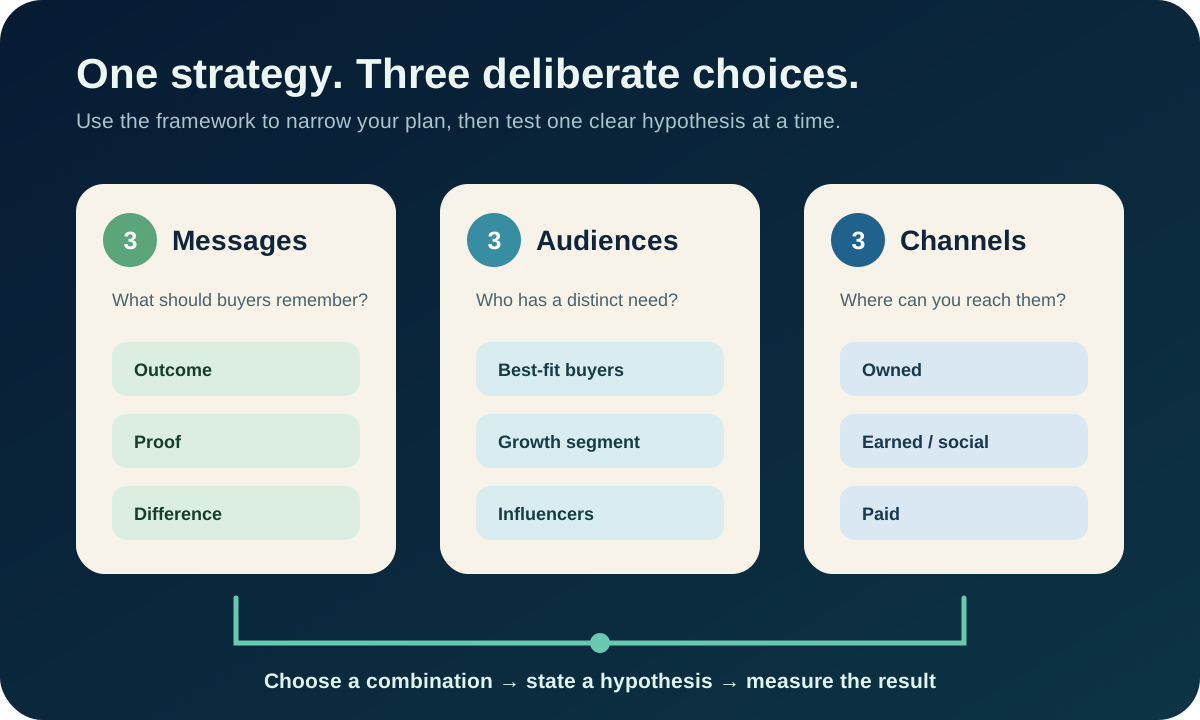
What each ‘3’ means
1. Three core messages
Your messages are the ideas you want a buyer to remember and repeat. They are not three slogans and should not be three long lists of features. A practical set usually covers:
- Outcome: the useful change the customer wants.
- Proof: the evidence that makes the promise believable.
- Difference: the reason to choose you instead of another option.
Suppose an SEO agency serves growing companies. Its three messages might be: attract more qualified non-brand traffic; see work and results in plain-language reporting; and fix technical problems before publishing more content. Each is specific enough to build a campaign around and broad enough to repeat.
A message fails the test if it could belong to every competitor. ‘Quality service,’ ‘innovative solutions’ and ‘we care about customers’ do not help a buyer distinguish one company from another.
2. Three audience segments
An audience segment is a group with a meaningfully different problem, buying trigger or decision process. Splitting ‘men’ and ‘women’ or ‘people aged 25–34’ is not useful unless that difference changes the offer, message or route to purchase.
Choose three groups your team can describe with evidence:
- 1Best-fit buyers: the customers who already get clear value from your offer.
- 2A growth segment: an adjacent group with a strong need and realistic acquisition path.
- 3Decision influencers: people who may not sign the contract but shape the shortlist, budget or approval.
For the SEO-agency example, those groups could be multi-location service businesses, ecommerce teams and finance or operations leaders who approve retainers. The same ‘more traffic’ line will not persuade all three. A local service operator may care about calls from specific towns, an ecommerce manager about non-brand revenue, and a finance lead about measurement and contract risk.
3. Three priority channels
Channels are the places where a message reaches an audience. Pick three that match buyer behaviour and your ability to execute—not the three platforms currently receiving the most attention.
- Owned: your website, email list, webinar or customer community.
- Earned or social: referrals, partnerships, public relations, LinkedIn or another relevant network.
- Paid: search, social, sponsorship or another controllable distribution source.
‘Social media’ is too vague to manage as one channel. Name the actual surface, format and job: for example, LinkedIn founder posts for credibility, Google Search ads for active demand, and an email sequence for leads who downloaded an audit checklist.
Why marketers use the rule
The value of 3-3-3 is managerial, not magical. It puts a boundary around a plan that might otherwise contain eight audiences, twelve claims and every available platform.
- Clarity: designers, writers, salespeople and leaders can see the same priorities.
- Consistency: the market encounters a recognisable set of ideas instead of unrelated weekly campaigns.
- Resource allocation: budget and creative effort go to channels the team can maintain.
- Learning: a smaller set of deliberate choices is easier to measure and improve.
There is no sound basis for saying three is the scientifically perfect number or that customers have a universal three-second attention span. Three is simply small enough to force prioritisation and large enough to preserve options.
The common mistake: treating 3 × 3 × 3 as 27 campaigns
Three messages, three audiences and three channels create 27 possible combinations. That is a planning space, not a launch checklist.
If you change the message, audience and channel at the same time, a result will not tell you which change mattered. Google Ads’ experiment guidance (opens in a new tab) recommends setting a clear hypothesis, testing one variable at a time and choosing the success metric before the test begins.
Start with the combinations that make commercial sense. An active-search message belongs in search. A detailed proof story may work better in email or on a landing page. A message for budget approvers may need a business case rather than a short social post.
A worked 3-3-3 example
| Choice | SEO-agency example | How to make it measurable |
|---|---|---|
| Message 1 | Win more qualified non-brand search demand | Qualified organic leads and non-brand conversions |
| Message 2 | Know what the agency did and what changed | Proposal-to-close rate and reporting satisfaction |
| Message 3 | Fix technical constraints before scaling content | Resolved blockers and indexed priority pages |
| Audience 1 | Multi-location service businesses | Leads from priority locations |
| Audience 2 | Ecommerce marketing teams | Non-brand revenue and profitable category growth |
| Audience 3 | Budget and operations approvers | Shortlist progression and sales-cycle friction |
| Channel 1 | High-intent search and comparison pages | Cost per qualified enquiry |
| Channel 2 | LinkedIn expert posts and direct follow-up | Relevant conversations and assisted leads |
| Channel 3 | Email audits and case-study sequences | Replies, booked reviews and opportunities |
One sensible first hypothesis would be: ‘For multi-location service businesses already comparing agencies, a proof-led landing page will generate more qualified audit requests than a generic grow-your-traffic page.’ That test uses the framework but still asks one answerable question.
How to build your own 3-3-3 plan
Step 1: Write down the business objective
Use a commercial outcome such as qualified enquiries, first purchases, renewals or sales opportunities. ‘Increase awareness’ is incomplete until you define the behaviour or evidence that would show useful awareness.
Step 2: List options before choosing three
Start with customer interviews, search data, sales calls, CRM notes and channel performance. Generate a wider list, then score each option for customer importance, evidence, reach, cost and your ability to deliver.
Step 3: Make each choice specific
Replace ‘small businesses’ with a group that shares a buying situation. Replace ‘be trusted’ with the proof that earns trust. Replace ‘Instagram’ with the content format, audience and action the platform should produce.
Step 4: Map combinations instead of filling every box
For each audience, identify the most relevant message and the channel where that audience is already receptive. Leave weak combinations blank. Focus is the point.
Step 5: Turn one combination into a hypothesis
Step 6: Set guardrails and a review date
Record the owner, budget, baseline, primary metric, quality guardrail and decision date. A campaign can produce cheaper leads while lowering their fit; a guardrail prevents the headline metric from hiding that damage.
Other meanings of the 3-3-3 rule
If someone asks you to ‘use 3-3-3,’ confirm what they mean before changing a plan. Common alternatives include:
- Attention and communication: capture attention quickly, communicate three ideas and reinforce them in three ways. This is common in advertising, displays and presentation advice.
- Content planning: rotate three content types, publish at a repeatable frequency and engage around each post. The exact buckets and cadence vary by author.
- Sales research: LinkedIn has described a separate 3×3 prospecting method (opens in a new tab) for finding useful information before outreach. That is a personalization habit, not the messages–audiences–channels framework.
None of these versions is automatically wrong. The problem is using the label without defining the three components.
When not to use 3-3-3
Ignore or adapt the rule when it hides meaningful differences. A one-product local business may need one audience and two channels. A global portfolio may need more than three segments, managed by separate teams. A regulated product may require messages that do not fit neatly into three cards.
Also avoid freezing the choices indefinitely. Review the framework when customer evidence changes, a channel becomes uneconomic, the offer changes or a segment repeatedly produces poor-fit demand.
The practical verdict
The 3-3-3 rule is useful when your marketing plan has become a catalogue of possibilities. Three messages, three audiences and three channels give a team a common map. The discipline begins after the map is drawn: choose the strongest route, state what you expect to happen, run a fair test and keep the learning.
If you are choosing an SEO partner to execute that plan, use the SEO company rankings to build a shortlist and compare the evidence behind each company’s score.
Frequently asked questions
What is the 3-3-3 rule in one sentence?
Focus your marketing on three core messages, three distinct audience segments and three priority channels, then test the strongest combinations.
Is the 3-3-3 rule an official marketing standard?
No. It is a flexible rule of thumb, and different marketers use the same name for different frameworks. Define the three components whenever you use it.
Does 3-3-3 mean I need 27 campaigns?
No. The framework creates 27 theoretical combinations, but you should select the combinations supported by buyer evidence and test answerable hypotheses rather than launch everything.
What is the 3-3-3 rule for social media?
There is no single social-media version. It usually combines three content categories, a repeatable posting cadence and a small engagement habit. Write down your version instead of assuming everyone uses the same buckets or frequency.
How often should I change my three messages, audiences and channels?
Review them on a planned cycle and when evidence changes. Keep them long enough to learn, but replace a choice when customer research, economics, performance or the offer shows it is no longer useful.
SEO Companies Hub Editorial
Directory Research
SEO Companies Hub publishes independent, research-backed guidance for US businesses choosing an SEO partner. We score agencies on published facts, separate marketing claims from evidence, and date-check anything that can change.