
Is Google Always Right? A Source-Checking Report
No—Google ranks and summarizes information rather than certifying every answer as true. This report shows how to verify results before trusting them.
Is Google always right? No. Google is extremely useful for finding information, but a result's position is not a certificate of truth. Google crawls pages, builds an index and uses automated systems to return what it believes is relevant and useful. The underlying page can still be wrong, stale, incomplete or deceptive—and a generated answer can misread it.
This report distinguishes ordinary web links from featured snippets, knowledge panels, local listings, ads, autocomplete and AI Overviews. Those surfaces are produced differently, so they fail in different ways.
What Google actually promises
Google's technical explanation of Search (opens in a new tab) describes three automated stages: crawling pages, indexing their content and serving relevant results. It also says that not every discovered page is crawled or indexed. When serving results, Google searches that incomplete index and returns pages it believes are the highest quality and most relevant for the query.
That is an ambitious information-retrieval promise, not a guarantee that every sentence is factually correct. Google's ranking systems guide (opens in a new tab) says its systems assess many signals across hundreds of billions of pages to produce relevant and useful results. The guide also describes systems intended to surface reliable information and warn when confidence in available results is low.
The important inference is straightforward: ranking evaluates signals and matches; it does not turn the ranked page into an official fact. A highly relevant page can contain a mistake. A generally reputable website can publish a weak page. A correct page can become outdated after the real world changes.
The answer depends on which Google surface you are looking at
A blue link, a map listing and an AI Overview should not receive the same level of trust merely because they appear on one results page.
| Google surface | What it represents | Main verification risk |
|---|---|---|
| Organic web result | A page ranked as relevant and useful | The publisher may be wrong, biased or outdated |
| Featured snippet | An extract selected from a web page | A short passage can omit qualifications or inherit the source's error |
| Knowledge panel | Automatically assembled information about an entity | Public-web data can be incomplete, disputed or stale |
| Maps or local profile | Information combined from businesses, users, licensed data and the public web | Hours, addresses, phone numbers and operating status can lag reality |
| Sponsored result | Paid placement labeled as sponsored | Payment and ad review are not an endorsement of every claim or destination |
| Autocomplete | A prediction based on searches, language, location, trends and other signals | A suggested phrase can look like an assertion even though it is not one |
| AI Overview or AI Mode | A generated synthesis intended to answer a question | The system can misinterpret the query, sources or nuance and present the synthesis fluently |
| Direct data feature | A calculation or data answer such as time, weather or a score | The data provider, update time, units or location can still be wrong for your need |
Ordinary results are recommendations to inspect
An organic ranking says, in effect, that Google's systems consider the page a useful match. It does not say Google authored, audited or legally guarantees the page. Read the result itself and ask who produced it, what evidence it cites and when it was updated.
Position also depends on context. Google says relevance can incorporate location, language and device. Two people can receive different local answers without either results page being a universal statement of fact.
Featured snippets can be confidently incomplete
Google says featured snippets come from web pages (opens in a new tab) and are selected when its systems determine that the format may help people find what they are seeking. A snippet can accurately quote a page yet leave out the sentence that limits the claim. It can also faithfully reproduce an error on that page. Open the cited result and read the surrounding context.
Knowledge panels and local listings are compiled, not handwritten verdicts
Google says knowledge panels are generated automatically (opens in a new tab) from public information, with feedback routes for inaccurate titles and facts. For local profiles, Google documents a mixture of business-provided information, public web content, licensed data and user contributions (opens in a new tab). That broad input is useful, but it also explains why an old phone number or changed opening time can persist.
Before visiting, calling or paying a business, compare the listing with the business's known official website. Google provides a Suggest an edit process (opens in a new tab) for incorrect names, addresses, hours, phone numbers and websites.
Autocomplete predicts queries; it does not declare facts
Google's own autocomplete explanation (opens in a new tab) is unusually direct: predictions are not assertions of facts or opinions, predictions are not perfect, and some may be less likely to lead to reliable content. Treat the dropdown as a typing aid—not evidence that a rumor is common, true or endorsed.
Sponsored does not mean verified as correct
Search ads are paid placements and are currently grouped under a visible Sponsored results label (opens in a new tab). That label distinguishes advertising from organic ranking; it does not remove the need to verify the advertiser and URL.
The US Federal Trade Commission warns that scammers can use search ads to impersonate businesses and place fake phone numbers in results. Its consumer guidance on scammy search results (opens in a new tab) recommends avoiding the assumption that the first phone number is legitimate and using a known official website when possible. For payments, account recovery or customer support, do not call or sign in through an unfamiliar result merely because it appears first.
AI Overviews can add a new error after retrieval
A generated answer introduces another transformation: the system must find information, interpret the query, combine sources and express a response. A source can be correct while the summary is wrong.
Google acknowledged this after launch in its account of inaccurate AI Overviews (opens in a new tab). It said some odd, inaccurate or unhelpful responses arose from misinterpreting queries, misreading web language and facing questions with little high-quality information. Google described technical changes, but the incident establishes the relevant point: polished wording and citations do not eliminate synthesis errors.
Open the supporting links and check whether each actually supports the sentence beside it. If the overview makes several claims, verify them separately. One good citation does not validate an entire paragraph.
Why Google can be wrong
Errors do not all come from the same place. Diagnosing the failure helps you decide what to check next.
- 1The source is wrong. Google may retrieve a page containing a fabricated claim, calculation error or unsupported opinion.
- 2The source is stale. Prices, office-holders, laws, product specifications, opening hours and medical guidance change.
- 3The query is ambiguous. A name may refer to several people; a rule may differ by country; ‘best’ depends on criteria Google cannot infer.
- 4The answer loses context. A snippet may omit a condition, denominator, date range or population.
- 5Reliable information is scarce. Google calls fast-moving or sparsely documented topics situations in which reliable information may be lacking. Researchers sometimes call these gaps data voids.
- 6A generated system misinterprets good material. AI can connect the wrong entities, mix time periods or overstate what a source says.
- 7Commercial placement is mistaken for authority. A well-positioned sponsored result can feel official even when it is merely an advertisement.
- 8Reality changed faster than the index. A road closes, a store moves or a new ruling supersedes the page already indexed.
- 9The result is subjective. Restaurant recommendations, political judgments and product rankings can be useful without having one objectively correct answer.
What research says about searching for the truth
Searching again does not automatically correct misinformation. A peer-reviewed Nature study on online search and misinformation (opens in a new tab) ran five experiments in a US news context. The researchers found that asking people to search online to evaluate false or misleading stories could increase belief in them. In one within-person experiment, searching raised the likelihood of rating a false story as true by 22%. In another analysis, 38% of people searching about false or misleading stories encountered at least one unreliable result, compared with 15% of those searching about true stories.
Those figures are not a universal ‘Google accuracy rate.’ They describe specific experiments, participants, news claims and search conditions. Their practical lesson is narrower and more useful: a poor verification query can lead directly into a cluster of pages repeating the same false claim. The study found that searches using a false headline or URL were especially associated with exposure to unreliable sources.
This explains why simple repetition is not corroboration. Five websites may all trace back to one unsupported post. Agreement matters only when the sources are genuinely independent and bring their own evidence.
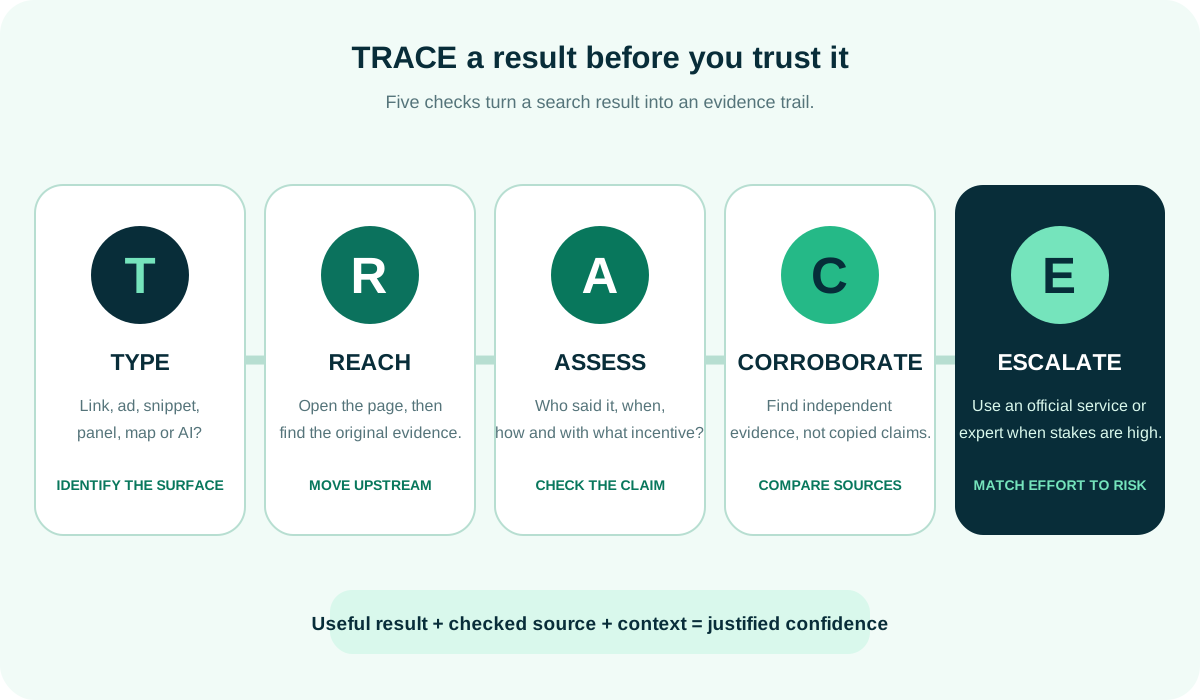
The TRACE method for verifying a Google result
Use this five-step check when an answer matters. It takes about a minute for a simple claim and longer for a consequential one.
T — Type of result
Identify what you are seeing: organic link, ad, snippet, panel, map listing or generated summary. Look for labels such as Sponsored and for source links attached to an AI answer.
R — Reach the original source
Open the result. Then move upstream: from a news article to the court filing, from a health blog to the guideline, from a chart to the dataset, or from a quoted statistic to the study. Search-result text is not enough.
A — Assess authority, date and incentive
Ask who is responsible, whether they have relevant expertise, when the material was updated and what they gain if you believe it. The World Health Organization's guidance for online health information (opens in a new tab) recommends checking who said it, when they said it and how they know, then comparing it with other credible sources.
C — Corroborate independently
Find a second source that did not merely copy the first. For public rules, use the regulator or statute. For a study, inspect the paper. For a company claim, compare official filings, product documentation or independently collected data. Search the claim's underlying subject rather than pasting an entire sensational headline.
E — Escalate when the stakes are high
A search result cannot examine you, represent you in court or know your complete financial circumstances. Use it to prepare better questions, then consult an appropriate professional or official service when an error could cause serious harm.
A risk-based verification table
| If the result concerns… | Prefer this final authority | Extra check |
|---|---|---|
| Medical symptoms or treatment | Public-health authority, clinical guideline or licensed clinician | Confirm applicability to your age, conditions and medicines |
| Law, tax or immigration | Current statute, court, regulator or qualified professional in the correct jurisdiction | Check effective date and location |
| Banking, investing or payment | Known official institution URL, regulator or formal disclosure | Never use a phone number or login page solely because an ad ranked first |
| Breaking news | Primary statement plus multiple credible newsrooms | Distinguish event time from publication time |
| Academic or scientific claim | Original paper, systematic review or official dataset | Read methods, sample and limitations |
| Local hours, address or route | Business or agency's official channel plus current map information | Call through a verified number if the trip matters |
| Product specification | Current manufacturer documentation | Match exact model, region and version |
How to search without reinforcing a false claim
A better query tests the claim instead of assuming it.
- Remove loaded language and search the underlying event, person or dataset.
- Add the jurisdiction and date when laws, prices or roles may differ.
- Add official, study, dataset, methodology or the responsible institution's name.
- Use a `site:` filter to find a document on a known authority's domain, but still inspect the document itself.
- Search for the strongest evidence against your first conclusion, not only confirmation.
- Check whether several articles cite the same original source.
- For an image, inspect its earliest credible context rather than trusting the caption attached to a repost.
For publishers, the same principle should shape content production: ranking is not proof of accuracy. Our AI-generated content evidence framework explains how to verify generated claims before publication, while the search intent mapping guide shows why a result can be relevant to one task and wrong for another.
When Google is probably good enough
Not every search needs a research project. A low-stakes query such as a spelling, rough definition, recipe idea or nearby café can often be acted on after a quick plausibility check. Verification effort should rise with the cost of being wrong and with signs of uncertainty.
Pause when the answer is surprising, emotionally provocative, unsupported, very recent, unusually precise, inconsistent with expert guidance or asking for money, credentials or urgent action. Those are not proof of falsehood; they are reasons to inspect the source.
The final verdict
Google is not always right, and Google does not need to be useless for that to matter. It is a powerful map of indexed information, optimized to help people reach relevant material. Maps can contain old roads; summaries can misread the terrain; paid signs can point somewhere profitable.
The safest habit is neither blind trust nor blanket distrust. Identify the result type, open the source, test its evidence, corroborate independently and match your verification effort to the stakes. Google is often the beginning of a good answer. It should not automatically be the end.
Frequently asked questions
Is the first Google result always correct?
No. First position reflects Google's ranking systems and the query context, not a guarantee of factual correctness. Open the page and verify its source, evidence and date.
Does Google check every website for truth?
Google uses automated ranking, reliability and spam systems, but its public documentation does not claim a sentence-by-sentence fact check of every indexed page. The web result remains the publisher's content.
Are Google AI Overviews reliable?
They can be useful starting points, but Google has acknowledged inaccurate and unhelpful AI Overviews. Check whether each cited page supports the generated claim, especially for high-stakes or fast-changing topics.
Are sponsored Google results trustworthy?
Sponsored results are advertisements. Google labels them and applies advertising policies, but you should still verify the advertiser, domain and claim. Use a known official URL for payments, support calls and account access.
Can Google Maps be wrong?
Yes. Local profiles combine information from businesses, users, licensed providers and the public web. Verify important hours, addresses and phone numbers through an official channel and submit a correction when needed.
Is autocomplete evidence that many people believe something?
No. Google says autocomplete is a prediction feature, not an assertion of fact or opinion. Its output also depends on language, location, trends and, in some cases, prior activity.
How many sources should I check?
There is no magic number. One primary authority may settle a simple official fact; a disputed or consequential claim may require several independent sources. Independence and evidence quality matter more than raw count.
Sources checked
- Google Search: how crawling, indexing and serving workprimary documentation for what organic ranking does.developers.google.comOpens in a new tab
- Google Search ranking systems guideprimary documentation for ranking and reliability systems.developers.google.comOpens in a new tab
- Google's AI Overviews post-launch reviewfirst-party acknowledgement and explanation of inaccurate generated answers.blog.googleOpens in a new tab
- Google featured snippets helpprimary explanation of snippet sourcing and feedback.support.google.comOpens in a new tab
- Google knowledge panel helpprimary explanation of automatic generation and corrections.support.google.comOpens in a new tab
- Google Business Profile source documentationprimary explanation of local information sources.support.google.comOpens in a new tab
- Online searches to evaluate misinformation can increase its perceived veracitypeer-reviewed experiments and stated limitations.nature.comOpens in a new tab
- FTC advice on misleading and scammy search resultsconsumer-protection guidance for ads, phone numbers and official sites.consumer.ftc.govOpens in a new tab
- WHO guidance for evaluating online health informationauthority, date, evidence and corroboration checks.who.intOpens in a new tab
For a measurement-focused view of how modern result layouts affect visits rather than truth, see our Google CTR statistics report.
SEO Companies Hub Editorial
Directory Research
SEO Companies Hub publishes independent, research-backed guidance for US businesses choosing an SEO partner. We score agencies on published facts, separate marketing claims from evidence, and date-check anything that can change.